
AI adoption is moving faster than most organizations can govern it.
Employees are experimenting with copilots, chatbots, research tools, coding assistants, content generators, meeting summarizers, and workflow automations. Executives are funding pilots. Vendors are promising productivity gains. Boards are asking where AI will create value.
But AI activity is not the same as AI readiness.
An organization can have active AI experiments, approved tools, and enthusiastic users — and still be unready to scale AI-enabled work. The real question is not whether people are using AI. The question is whether the organization has the people capability, workflow discipline, data readiness, governance, and operating model needed to use AI responsibly and repeatedly.
That is what an AI readiness assessment should answer.
Why AI readiness matters now
The market has moved from AI curiosity to AI pressure. The Stanford AI Index 2025 reports that organizational AI use rose sharply, while private investment in generative AI continued to grow.[1] At the same time, consulting and research firms are finding a widening gap between organizations experimenting with AI and organizations generating material value from it.
BCG describes this as a separation between a small group of “AI future-built” companies and a much larger group still scaling or experimenting.[2] McKinsey’s 2025 research similarly emphasizes that capturing AI value depends on more than technology. It depends on strategy, talent, operating model, data, technology, and adoption at scale.[3]
That is the point: AI readiness is not a software question alone. It is a management question.
Can the organization connect AI to business value? Can people use it responsibly? Can workflows absorb it? Can outputs be reviewed? Is the data good enough? Are governance and escalation clear? Do leaders know where to move fast and where to slow down?
Without answers to those questions, AI adoption becomes a collection of disconnected experiments.
A simple definition
An AI readiness assessment is a structured evaluation of whether an organization is prepared to adopt, govern, and scale AI-enabled work.
A good assessment looks at the conditions around AI use, not just the tools themselves. It should examine:
- whether AI initiatives are connected to business priorities
- whether employees have practical AI operating capability
- whether workflows are ready to change
- whether data and evidence are reliable enough for AI-supported work
- whether governance, privacy, risk, and human review expectations are clear
- whether departments have the leadership and adoption discipline to scale
- whether enablement can be targeted to actual capability gaps
The output should not be a vanity score. It should be a practical view of what is ready, what is exposed, and what needs to be fixed.
AI readiness is broader than AI literacy
AI literacy matters. People need to understand what AI is, what it can do, where it can fail, and why human judgment remains important.
But AI literacy is only the starting point.
A person can understand AI concepts and still struggle to use AI responsibly inside a real workflow. They may know how to write a prompt but not know how to verify the output. They may understand that AI can hallucinate but not know when escalation is required. They may be confident using a tool but unaware of privacy, evidence, or governance implications.
That is why a serious readiness assessment should measure AI operating capability, not just awareness.
AI operating capability asks practical questions:
- Can users frame AI-supported tasks clearly?
- Can they identify where AI fits into a workflow?
- Can they check AI output against evidence or approved sources?
- Can they recognize when human review is required?
- Can they identify privacy, compliance, or customer-impact risk?
- Can managers provide oversight for AI-enabled work?
This distinction matters because organizations do not scale AI literacy. They scale changed work.
What a serious AI readiness assessment should measure
A credible assessment should look across the operating system of the organization.
01
Strategic readiness
AI should be tied to clear business outcomes. If a use case is not connected to value, it will be hard to prioritize, fund, govern, or measure.
A readiness assessment should ask whether AI is being used to improve specific outcomes such as productivity, quality, risk reduction, customer experience, cycle time, cost, or revenue.
02
People capability
AI value depends on whether people can apply AI well in their roles. This includes task framing, prompt design, workflow thinking, evidence use, risk judgment, human review, and adoption behavior.
Training attendance is not enough. A person may complete AI training and still lack the judgment required to use AI safely in real work.
03
Workflow readiness
AI usually creates value when work changes. It may alter process steps, handoffs, review points, quality checks, escalation paths, and decision rights.
A readiness assessment should identify where AI fits into the workflow, what remains human-led, and what controls are needed before the process scales.
04
Data and evidence readiness
Poor data quality can weaken even promising AI initiatives. Gartner has warned that many AI projects are at risk when they are not supported by AI-ready data.[4]
Readiness therefore includes more than access to data. It includes data quality, approved sources, traceability, security, governance, and the ability to verify AI outputs against reliable evidence.
05
Governance and risk readiness
AI introduces risks around privacy, bias, accuracy, intellectual property, explainability, accountability, and regulatory exposure.
Organizations need clear rules for acceptable use, human oversight, review, escalation, and monitoring. Frameworks such as the NIST AI Risk Management Framework, OECD AI Principles, ISO/IEC 42001, and the EU AI Act all point toward the same direction: AI governance must become operational, not just aspirational.[5][6][7][8]
06
Department readiness
AI does not scale evenly across the organization. One department may have strong leadership, clean workflows, and good data. Another may have enthusiasm but weak process ownership and unclear governance.
That is why readiness should be measured at department level, not only enterprise level. Leaders need to know where AI can scale and where the foundations need repair first.
The common mistake: confusing experimentation with readiness
Many organizations are already active with AI. That activity can create the impression of progress.
But experimentation answers only one question: are people trying AI?
Readiness answers a better question: can the organization use AI safely, consistently, and with measurable value?
The difference is important.
Experimentation can happen informally. Readiness requires discipline. Experimentation can be driven by individual enthusiasm. Readiness requires workflow design, data practices, governance, capability building, and leadership ownership.
When organizations skip readiness assessment, they often scale the visible parts of AI — tools, pilots, demos, training sessions — while underestimating the invisible foundations that determine whether AI creates value.
A practical readiness model
A useful AI readiness assessment should create a connected view across three levels.
Individual readiness
Can people use AI responsibly in their work?
This includes AI literacy, task framing, workflow thinking, evidence use, human review, governance awareness, adoption behavior, and oversight.
Department readiness
Can the department absorb AI-enabled change?
This includes leadership support, workflow clarity, data readiness, systems fit, governance, adoption capacity, and the ability to scale improvement over time.
Enterprise readiness
Can the organization govern and scale AI across functions?
This includes operating model, risk management, initiative prioritization, common standards, enablement strategy, and executive visibility.
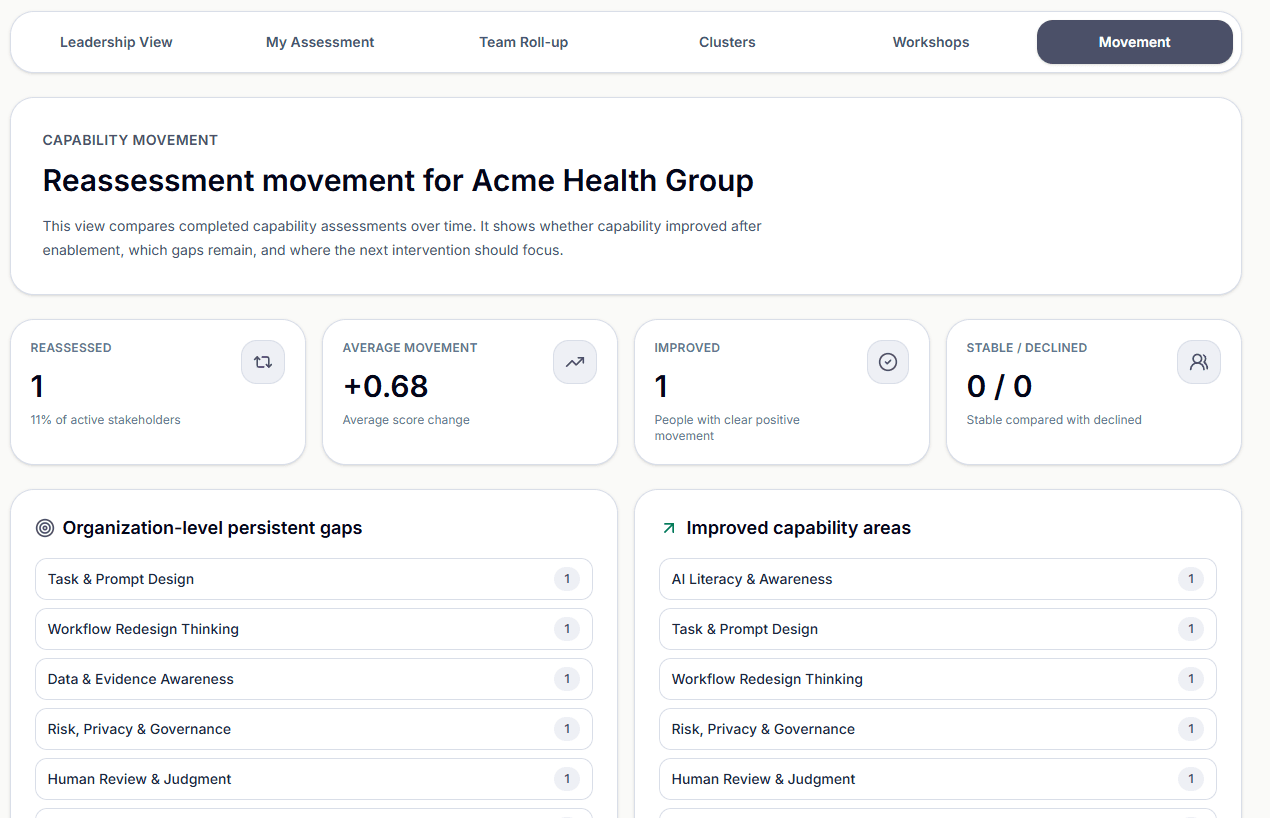
The strongest assessments connect all three. Individual readiness shows where people need support. Department readiness shows where AI can scale. Enterprise readiness shows whether the organization has the management system to govern AI adoption.
The outcome should be a fix plan
A readiness assessment should not end with a label such as “low,” “medium,” or “high.” That is useful, but insufficient.
The better output is a fix plan.
A fix plan answers:
- Which areas are ready to move?
- Which teams need enablement?
- Which workflows need redesign?
- Which data or evidence issues must be resolved?
- Which governance gaps create exposure?
- Which AI initiatives should be prioritized, delayed, or redesigned?
- How will the organization reassess progress?
This is where AI readiness becomes operational. It turns AI from a technology discussion into a management system.
Bottom line
An AI readiness assessment is not about proving that an organization is innovative. It is about understanding whether the organization is ready to use AI in a disciplined, responsible, and value-generating way.
The organizations that win with AI will not simply be the ones with the most tools or the most experiments. They will be the ones that connect AI activity to people capability, workflow redesign, data readiness, governance, leadership ownership, and measurable adoption.
AI readiness answers the question leaders should ask before scaling:
Are we ready to turn AI activity into AI operating capability?
Sources
- [1] Stanford HAI — The 2025 AI Index Report
- [2] BCG — Are You Generating Value from AI? The Widening Gap
- [3] McKinsey — The State of AI: Global Survey 2025
- [4] Gartner — Lack of AI-Ready Data Puts AI Projects at Risk
- [5] NIST — AI Risk Management Framework
- [6] OECD — AI Principles
- [7] ISO — ISO/IEC 42001 Artificial Intelligence Management System
- [8] European Commission — EU AI Act